
Software development is going through one of the biggest transformations in its history. In just a few years, AI has grown from a simple autocomplete into a capable development partner — one that writes code, generates documentation, reviews pull requests, creates tests, and even proposes architectures. The question is no longer whether developers should use AI, but how effectively they can weave it into their workflow.
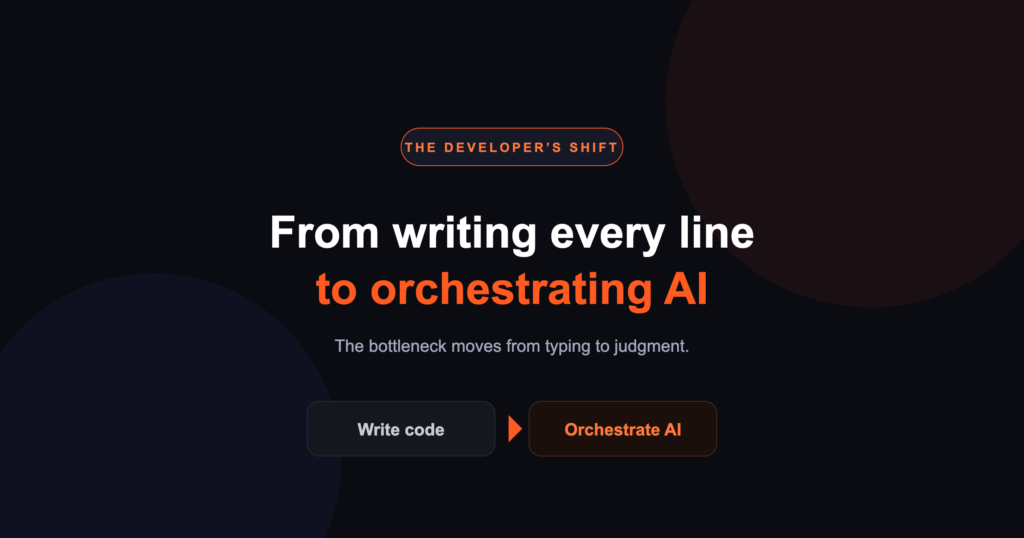
This is not a story about AI replacing engineers. It is about freeing developers to focus on higher-value work while AI handles the repetitive, time-consuming parts. The role is shifting from hand-writing every line to supervising intelligent systems, validating their output, and making the strategic calls.
From coding to problem solving
For decades, development mostly meant translating requirements into code, and success was measured by how quickly and accurately you could implement a feature. Modern models can now generate whole functions, build APIs and interfaces, write tests and suggest architectural improvements in seconds. So the hard part is no longer typing — it is defining the problem clearly and supplying enough context for the system to produce a good solution. Developers are becoming problem solvers, system designers and decision-makers whose value comes from understanding the business, weighing trade-offs, ensuring quality, and steering AI toward the right outcome.
The economics of AI development: tokens
An overlooked part of AI-assisted work is the token. Every prompt, snippet, doc page and response consumes tokens, and tokens map directly to cost and performance. Large codebases can burn thousands of tokens in a single interaction, so developers have to learn to be economical — stripping unnecessary comments, dropping unused imports, and sending only the relevant sections. Careful context hygiene can cut token consumption meaningfully (industry estimates put it around 30–40%) while actually improving answer quality. As teams lean harder on AI, token efficiency is becoming as important a discipline as application performance or cloud spend.
Choosing the right model
The model landscape has expanded fast, and different families suit different jobs:
- OpenAI’s GPT models — strong at architecture design, debugging complex systems and orchestrating agent workflows.
- Anthropic’s Claude models — known for reasoning, large context windows and excellent refactoring and documentation.
- Google’s Gemini models — multimodal with very large context windows, ideal for analysing big repositories and visual inputs.
- Open-source options (DeepSeek, Llama, Qwen) — cost-effective when privacy, customization or self-hosting matter.
Rather than betting on one model, many teams now run a multi-model strategy, routing each task to the tool that fits — maximising quality while controlling cost.
The rise of AI-native tools
Alongside the models, a new generation of AI-native tooling is reshaping the workflow. IDEs like Cursor bring code generation, repository-wide chat and contextual editing right into the editor. Windsurf pushes toward autonomous workflows where the AI can plan, implement, test and refine a feature with minimal intervention, and Antigravity goes further with multi-agent systems that coordinate complex tasks and run browser-based testing. On the command line, agents such as Codex CLI, Claude Code and Aider automate work directly from the terminal and slot into CI/CD pipelines, infrastructure management and large-scale refactors. The line between “coding” and “automation” is disappearing as AI embeds into every stage of the lifecycle.
Prompt engineering: a new core skill
The quality of what a model produces depends heavily on the quality of the instructions it is given. A vague prompt yields incomplete or wrong results; a well-structured one — with a clear role, constraints, context and an expected output format — dramatically improves accuracy and cuts down on revisions. Instead of “fix this bug,” an effective prompt specifies the language and framework, the desired behaviour, the existing constraints, the expected output structure, and the relevant code and architecture. That detail is what gets output close to production quality — which is why prompt engineering is becoming as valuable as traditional coding.
Real-world productivity gains
The impact is already substantial: work that used to take hours or days can now take minutes. Generating APIs, writing unit tests, reviewing pull requests, optimising databases and producing documentation are all areas where AI delivers consistent time savings — documentation that once took a week can be drafted in minutes, and legacy systems can be analysed and documented with unusual speed. That headroom lets teams spend more time on innovation and less on repetitive implementation.
The caveat matters: AI-generated code still needs human oversight. Developers remain responsible for security, performance, maintainability and business correctness. The most effective teams treat AI as a powerful assistant, not an autonomous replacement — more output only counts if quality keeps pace.
The developer of the future
As AI evolves, so do the skills that define great engineers. System design, architecture, communication, prompt engineering and AI orchestration are rising in importance; deep technical knowledge still matters, but so does the ability to collaborate with intelligent systems. The developers who thrive will not be the ones who type the most code — they will be the ones who define problems clearly, pick the right tools, guide AI effectively and make sound engineering decisions.
The future belongs to engineers who combine human creativity, critical thinking and domain expertise with the speed and scale of AI. It is not replacing developers — it is elevating them. At Orthonity we help engineering teams make exactly this shift: adopting agentic tooling in a way that increases output without giving up the quality and accountability their systems depend on.