
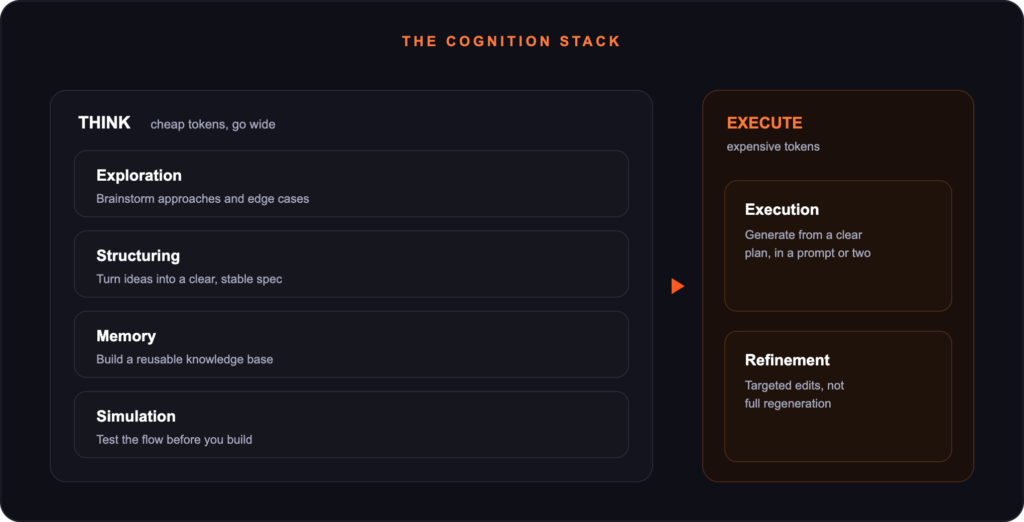
Most people use AI in a way that feels productive but does not scale. You open a tool, write a prompt, get an output, tweak it, regenerate, tweak again. It works for a while — then the work gets more complex (codebases, product flows, presentations) and the process starts to break down. Outputs get messy, structure drifts, and you spend more time fixing than building.
The problem is not the tools. It is how we use them. The default loop looks like prompt → output → iterate → repeat, and that loop pushes all of the thinking into the execution phase — which is exactly where tokens are most expensive.
Separate thinking from doing
The fix is to stop treating AI as a generator and start treating it as a system you move through in stages — each with a purpose and the right tools.
1. Exploration — go wide first
Explore the problem space with general tools like ChatGPT, Claude and Gemini: brainstorm approaches, compare ways to solve it, ask “what can go wrong?”, and probe edge cases. Do not aim for clean output here — this stage is messy by design, and it is cheap. Spend tokens freely: ask more questions, explore several directions, discard ideas without guilt. There is no pressure to get it right in one shot. By contrast, production tools are where every iteration gets expensive and leaves messy artifacts to clean up later.
2. Structuring — turn ideas into decisions
This is the step most people skip, and where most of the efficiency is won. Take what you explored and turn it into something clear: steps, constraints, components, flows. Ask the model to “summarize the decisions,” “create a final spec,” and “list the assumptions and constraints,” then store it somewhere durable like Notion or Obsidian. You should come out of this stage with a clean, stable spec — because if it is not clear here, execution will be messy no matter which tool you use.
3. Memory — build a reusable knowledge base
Good thinking should not evaporate the moment a chat closes. Use a tool like NotebookLM to upload your docs, specs and research, query across past work, and refine ideas over time. This becomes a long-term advantage: instead of rethinking from scratch, you keep evolving what you already worked out.
4. Simulation — test before you build
Before you touch production tools, simulate. Have the model act as a user, walk through your flow, surface edge cases and stress-test your assumptions. This catches problems early — before a line of code is written or a screen is designed.
5. Execution — generate with clarity
Now move to production tools: Cursor or Antigravity-style workflows for code, Lovable or Figma for UI, and Claude or ChatGPT for structured slide generation. You are not exploring anymore — you are executing a clear plan. Aim for one or two prompts, not ten.
6. Refinement — iterate without breaking everything
Iteration still happens, but it is controlled. Instead of “regenerate everything,” say “change only this section,” “improve clarity without changing the structure,” or “refactor this component only.” Tools like Cursor are powerful here precisely because they allow targeted edits rather than full regeneration.
Flip the default
Most people try to save tokens during thinking and then burn them during execution. This flips it: spend tokens upfront to think properly, so you do not have to keep redoing the work later.
Why it matters as you scale
As your work grows — larger codebases, more complex products, multi-step workflows — the cost of bad structure compounds. Without structure, every change leads to rework, outputs drift, and systems get harder to maintain. With structure, execution becomes predictable, changes are easy, and outputs stay consistent.
Where the work really happens
AI is extremely good at helping you think — if you let it. Rush straight into generation and you force it to think and build at the same time, which is where most inefficiency comes from. AI does not remove thinking; it just exposes poor thinking faster. Slow down, get clarity first, and execution becomes almost trivial. The difference is not how much you use AI — it is where. Think wide, structure clearly, execute once. At Orthonity we design agentic systems around exactly this separation, so the automations we build stay reliable as the problems they handle get harder.